

At its core, design thinking is a structured way to solve problems by putting people at the center of the process. It’s an approach that asks us to pause before rushing into requirements gathering or solution design and instead start with empathy: What are our users really experiencing?
This process, popularised by IDEO and now used by companies like Apple, IBM, and Google, is about iteration and collaboration. Rather than gathering requirements once and handing them off, design thinking encourages you to explore the problem deeply, brainstorm widely, prototype quickly, and test often.
Why Design Thinking Matters for Business Analysts
Design thinking helps you solve the right problems, faster, and with better results.
Here’s what it does for you:
Find the real problem: By empathising with users first, you avoid building features nobody needs, saving time, money, and frustration.
- Align stakeholders quickly: Collaborative workshops and visual techniques get everyone on the same page, reducing rework and conflict.
- Speed up requirements: Prototypes and user feedback make requirements clearer, so you spend less time revising documents.
- Reduce project risk: Testing ideas early catches usability issues before development, avoiding expensive late-stage fixes.
- Boost innovation: You uncover creative, user-centered solutions that deliver real business impact, and position yourself as a strategic BA.
The 5 Phases of Design Thinking (and How BAs Can Use Them)
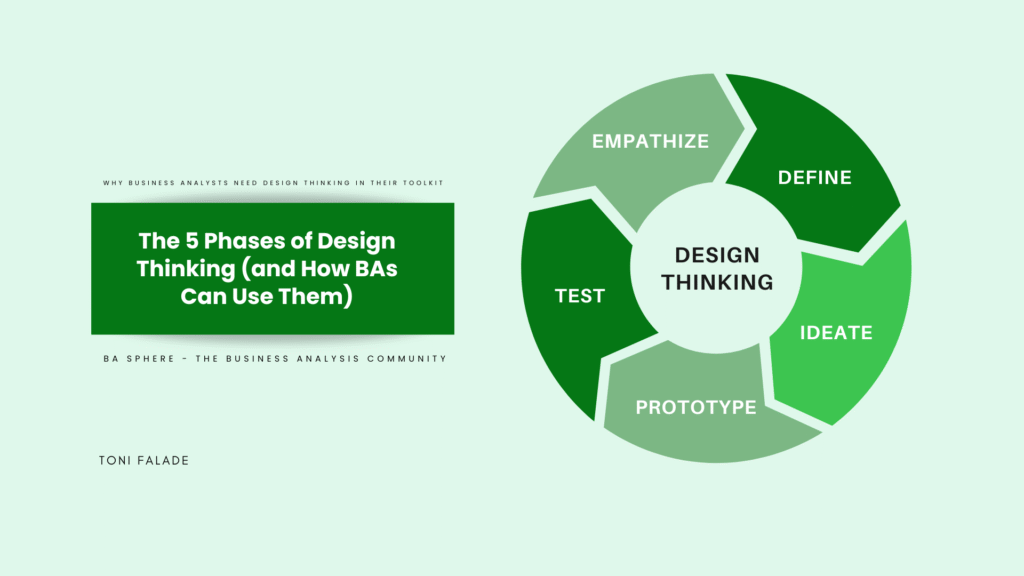
Design thinking follows five core phases — Empathize, Define, Ideate, Prototype, and Test.
Each phase has a distinct purpose, but they aren’t strictly linear. You may cycle back and forth as you learn more about your users and refine your solutions.
Let’s unpack each phase with BA-specific context, examples, and practical tools you can use right away.
Empathize – Step Into the User’s Shoes
What it means:
Empathy is the foundation of design thinking. This phase is about deeply understanding the people you are designing for — their needs, pain points, behaviors, and motivations.
Example:
Imagine you’ve been asked to improve a hospital’s appointment scheduling system. Instead of immediately gathering requirements from management, you spend time shadowing receptionists, speaking with patients, and observing how they currently book appointments. You might discover unexpected frustrations, like patients struggling with medical terminology or staff having to manually call people back because the online form fails to capture key information.
Techniques that work for BAs:
- User Interviews – Ask open-ended questions to uncover challenges and emotions.
- Job Shadowing / Observation – Watch users interact with current systems or processes.
- Empathy Maps – Capture what users say, think, do, and feel to visualize their experience.
- Surveys or Polls – Gather quick quantitative data at scale.
Define – Frame the Right Problem
What it means:
Once you’ve gathered user insights, the next step is to synthesize them into a clear problem statement. This ensures everyone on the project is solving the same problem — and the right problem.
Example:
Instead of saying “We need a better scheduling system,” you might define the problem as:
“How might we reduce patient booking errors so they can confirm appointments without requiring staff intervention?”
This reframed problem statement is user-centered, measurable, and solution-agnostic.
Techniques that work for BAs:
- Affinity Mapping – Group insights from interviews into common themes.
- Persona Creation – Build profiles of typical users to focus discussions.
- Problem Statement Frameworks – Use “How Might We…” or “Point-of-View” statements to frame challenges.
- Current-State Process Mapping – Identify bottlenecks and pain points in existing workflows.
Ideate – Explore Possibilities
Ideation is where creativity happens. The goal isn’t to find the perfect solution immediately, but to generate a wide range of possible solutions.
Example:
Continuing with the hospital scheduling scenario, you might brainstorm ideas such as:
- A chatbot that helps patients choose the right type of appointment.
- A mobile-friendly calendar view with real-time availability.
- An automated confirmation and reminder system via text message.
Techniques that work for BAs:
- Brainstorming Sessions – Encourage wild ideas before narrowing down.
- Mind Mapping – Visualize related ideas and expand thinking.
- Crazy 8s – Have participants sketch eight ideas in eight minutes to push beyond obvious solutions.
- SCAMPER Technique – Substitute, Combine, Adapt, Modify, Put to another use, Eliminate, Reverse.
Prototype – Make Ideas Tangible
Prototyping brings ideas to life in a low-risk, low-cost way. The goal is not to create a finished product but to create something stakeholders and users can react to.
Example:
For the appointment system, you might create:
- A clickable wireframe of a simplified booking page.
- A sample SMS confirmation message flow.
- A paper sketch of a redesigned intake form.
You then share these prototypes with users to see how they interact and what they find confusing.
Techniques that work for BAs:
- Low-Fidelity Wireframes – Use tools like Miro, Figma, or Lucidchart.
- Process Flows – Visualize new workflows for discussion.
- Storyboarding – Show the user journey step by step.
- Mock Data Scenarios – Test how real data would flow through a proposed process.
Test – Validate and Refine
Testing helps you gather feedback, validate assumptions, and iterate on your solution. This is not the final step — it often sends you back to refine your prototype or even revisit your problem definition.
Example:
You ask patients to use the new booking prototype. Some love it, but you discover that older patients find the mobile calendar hard to navigate. This insight leads to a new design iteration with clearer labels and bigger touch targets.
Techniques that work for BAs:
- Usability Testing – Observe real users completing tasks with your prototype.
- A/B Testing – Compare two variations to see which performs better.
- Feedback Workshops – Gather stakeholder reactions and prioritize changes.
- Pilot Programs – Roll out a solution to a small group before a full launch.
Key Takeaway
These five phases aren’t a rigid checklist but a flexible playbook. You might move back and forth between stages as you uncover new insights. The goal is to reduce risk, align stakeholders, and build solutions that truly work for the people who will use them.