
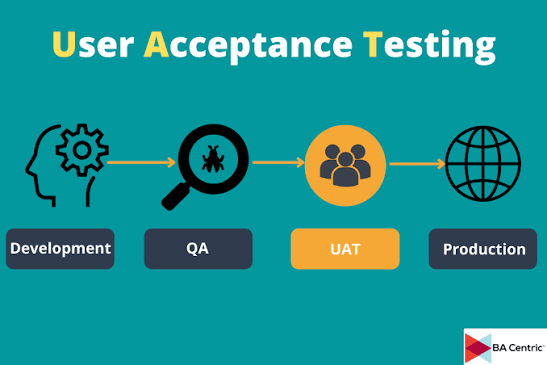
What is User Acceptance Testing (UAT)?
User Acceptance Testing (UAT) is the final checkpoint before a solution is released to production. It is carried out by business users (not developers or QAs) to verify that the system truly meets the documented business processes and agreed upon acceptance criteria. Unlike integration testing or system testing which confirms if the software works, UAT answers:
“Does this solution help the business achieve its purpose?”
Why Is the Business Analyst So Critical to UAT?
Throughout the whole project the BA has been there with stakeholder’s to understand business goals, gather requirements, define acceptance criteria. During UAT, they assure those requirements are met. BA acts as the bridge between business and technical.
They make sure business understand the system and developers understand business expectations.
The BA’s Role During UAT
BA’s work during UAT can be divided into three parts: Preparation, Execution and Defect Management.
Part 1: Preparation phase
It is about making sure that the UAT run well, there are no chaos.
1. Define Scope of UAT
The first thing for the BA to do is define what to test. Not all features should be tested. BA works with stakeholders to understand critical business processes, high risk functionality, new features, regulatory requirements, business rules. Defined scope prevents unnecessary testing and scope creep.
2. Prepare UAT test cases
Once the scope is defined, BA creates UAT test cases focused on business aspects. Unlike QA’s test cases, these tests reflect user scenarios: What is the business objective? What should the user do? What result the user should get. The results are compared against business goals.
3. UAT Environment Coordination
Well written test cases are useless on a test environment that is not properly setup. BA works with technical teams to ensure the right application is deployed on the test environment and the business users are granted all the necessary accesses. Missing User account or test data cause much delay during UAT.
Part 2: Execution and Facilitation phase
This is the phase where the BA is the first point of contact for business users:
1. Organize UAT Kick-Off Meeting
BA organized kick-off session to align all involved parties regarding UAT goals, schedule, roles and responsibilities, test execution process and defects reporting. Users will then know what to do.
2. Assist Business users
Business users are experts in their work, but not expert testers. BA assist them on answering business rules questions, clarifying their queries and guiding the testing scenario, without performing the testing itself.
3. Monitor test execution
The BA continually monitor the testing progress by keeping track of the test case execution status and the number of test cases passed and failed. These are reported to stakeholders to keep them informed.
Part 3: Defect Management and Business Sign-Off
Not all reported items during UAT is a defect. Here is whereBA’s analytical skill becomes valuable.
1. Triage defects
Before developers fix issues, BA review each item reported, decide if it’s a real defect, a misunderstanding, missing data, misconfiguration, a new feature requested, or a future enhancement. This prevents developers from wasting their time on non-critical items and saves project from scope creep.
2. Coordination of retesting
Once defects are fixed by developers,BA makes sure the test cases are retested to confirm that the defects are fixed and that the defect resolution does not cause any negative impact on the system.
3. Facilitate Business Sign-Off
The last duty for BA is to get the final business sign-off. BA has to make sure that all critical test cases have passed, all High Priority defects are resolved and Business users are happy with the deliverables, and all required documents are ready. The solution only goes to production after the final sign-off.
Conclusion
UAT is more than just a testing stage. It is a business’s final opportunity to verify that the intended value of the solution has been delivered. For the BA, UAT transforms their documentation into tangible solutions. It is a process where business requirements are validated and user expectations are met with confidence before goes live. A business analyst ensures not only that software is technically sound, but also fit for its purpose. A perfect UAT is concluded not with a “Pass.” but with the satisfaction:
“This solution is the right answer for our needs, and we are good to go.”